Marcus Reed · REED KEYSTONE · Retired Army First Sgt.
37 people are looking at this page right now
Straight from my short videos · With the answers to every question they left open

What the survival stores won't tell you – and why, when the power goes out, your water runs out long before your food.

From my years as an Army First Sergeant, keeping 200 soldiers fed and ready: REED KEYSTONE, the complete home survival guide (149 pages) with every gallon, drop, degree and dollar, 72 video answers and a 30-day plan in large print – plus 2 bonus guides (79 pages) and the app, free today.

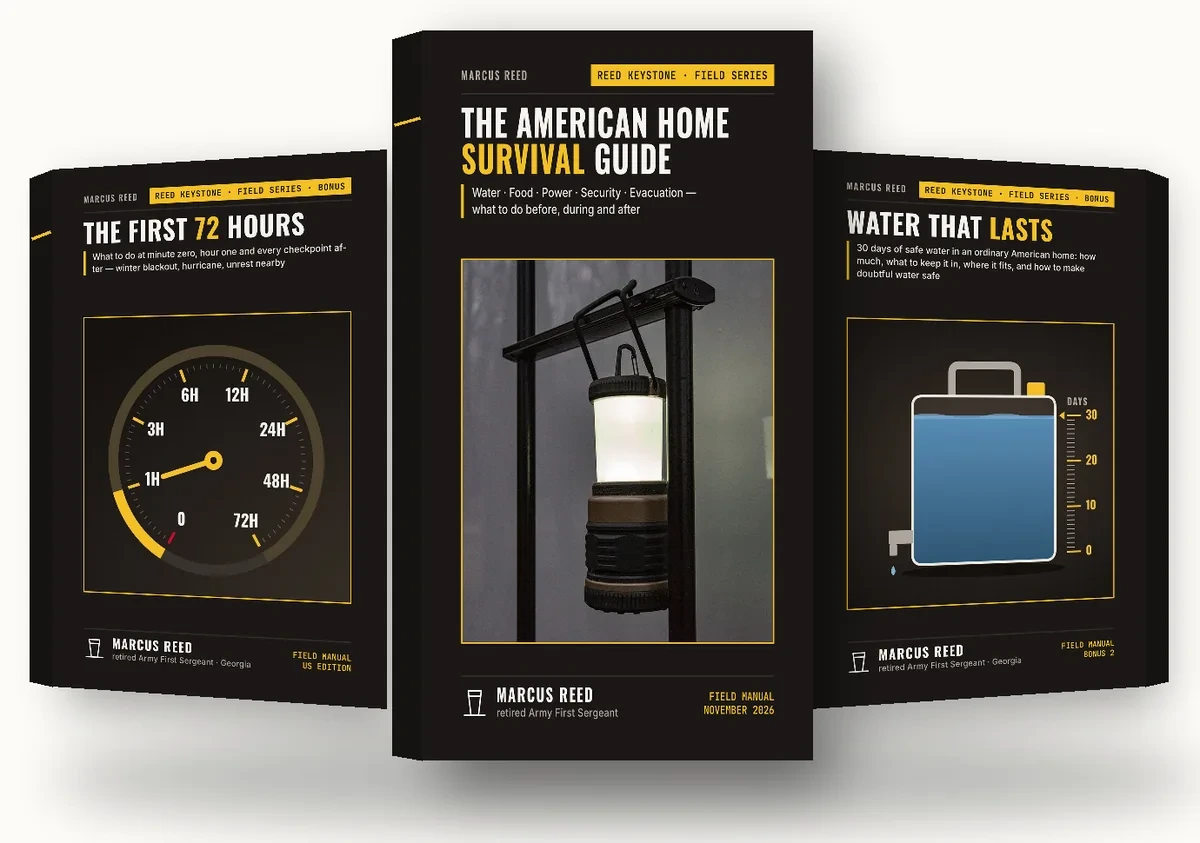
REED KEYSTONE, the complete survival guide for American homes, with the two free bonus guides The First 72 Hours and Water That Lasts
Main guide (149 pages) + FREE: The First 72 Hours (41 pages · $0) + FREE: Water That Lasts (38 pages · $0) + FREE: phone app, nothing to install ($0)
Special price for my video viewers (24 hours only): 23:59:59
was $49.90 only $19.90 −60% · You save $30.00

Complete package (228 pages): main guide + both bonus guides + the companion app, all included for $0 extra · One payment, no subscription.

Get the complete package for $19.90 →

Secure checkout by Hotmart · Instant access by email on phone, tablet and computer, ready to print · 7-day money-back guarantee

Real numbers, not fear

Does any of this sound like your house?

In my years in uniform, the thing that hurt people most in a crisis was never the thing they'd been afraid of. It was the boring failure they didn't see coming:

1. The fridge everybody opens "just to check"

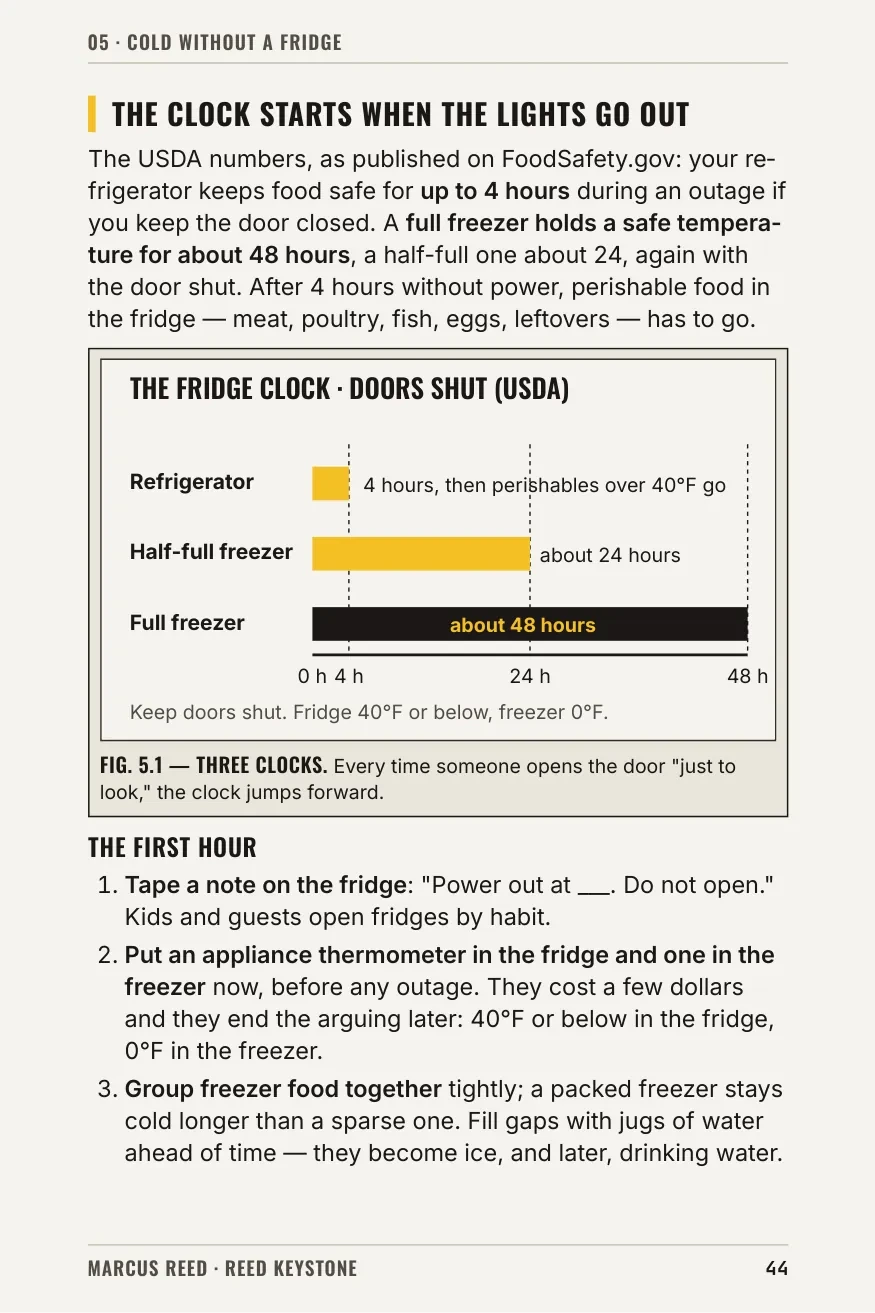
With the door shut, a fridge keeps food safe for about 4 hours. A full freezer holds about 48, a half-full one about 24 (USDA). Every peek moves that clock forward, and after 4 hours anything perishable above 40°F goes on the throw-out list.

2. The tap that goes dry, or goes bad

City pumps run on electricity. In February 2021 about 14.9 million Texans were under boil-water notices on a single day, and after Hurricane Helene, Asheville went 53 days without drinkable tap water. The water people did store often sits in milk jugs that crack and feed bacteria.

3. The heater or grill that kills without a sound

Carbon monoxide has no color and no smell. The CDC says it kills more than 400 Americans a year in accidents not linked to fires: a generator in the garage, a grill brought inside "just for an hour". In the Texas freeze of 2021, 19 of the 246 deaths were carbon monoxide (Texas DSHS).

4. No cash, no refills, no papers when you need them

Card readers, ATMs and gas pumps die with the power, and the stores that open take cash only. By day three to seven, prescriptions run short for anyone who didn't refill early. And a standard homeowners policy often pays only $200 for stolen cash.

That's exactly why I wrote this guide: no fear, no gear to sell, no "trust me". Exact numbers in gallons, drops, degrees Fahrenheit, hours and dollars, each one from Ready.gov, FEMA, the CDC, the EPA, the USDA or the Red Cross, so you can get your own house ready, one short task a week.
149-page main guide · 24 diagrams · 7 print-and-keep sheets

What's inside (with real numbers from the guide)

Came here from one of my short videos? Here's where the answer is:
  • Video 03 (the gap under your kitchen cabinets): the toe-kick space (about 16 cans per foot) and the four more places nobody opens p. 121
  • Video 04 (meat buried in salt in the garage): why a garage cooler is not a method, the three other salt tricks, and what to do with a dying freezer p. 106
  • Video 14 (the boot print on the front door): the boot print and three more, without copying an official mark p. 124
  • Video 15 (the fridge taped shut): the taped fridge, the diaper pail and two more, with the child-safety rule p. 124
  • Video 16 (the gravel, sand and charcoal filter): how to build it, and the step that actually makes the water safe p. 99
  • Video 17 (seven cans for the shelf): the seven, and the one almost nobody has p. 108
  • Video 22 (five free places for water): all five with gallons, and the biggest free source that isn't on the list p. 100
  • Video 23 (your number on your arm in marker): the four free things for the first night of an emergency order p. 117
Show the other 16 videos and their pages
  • Video 24 (sealing Mason jars): how to seal dry food in about 30 seconds, and what must never go in p. 109
  • Video 32 (twenty minutes to evacuate): the four free things, and the last one most people get wrong p. 117
  • Video 33 (five things at Home Depot): the five, and the bucket mistake p. 114
  • Video 34 (the red sign on the front door): why I won't print it, and the legal way to stay off the list p. 127
  • Video 37 (the Christmas tree box): the three boxes, and the one room where the decoy cans go p. 128
  • Video 42 (the hand-sanitizer stove): the safer fuel I'd use instead, and three fuel stretchers p. 103
  • Video 46 (the spice rack when pharmacies close): what ginger, clove, cayenne and turmeric can and can't do, and why your doctor comes first p. 115
  • Video 49 (rice in the laundry basket): the basket and three more nobody touches p. 130
  • Video 51 (the mirror on the pantry door): the mirror door and three more doors I hid p. 131
  • Video 52 (light the house with no power): all five lights with the rule for each, and the no-flame one I prefer p. 104
  • Video 62 (forget the safe, grab the folder): what goes in the folder, and the rest of a five-minute exit p. 119
  • Video 64 (the candle in the window): how far a candle really shows, and three more giveaways p. 133
  • Video 65 (get your rice out of that bag): mylar, absorbers and a bucket, and what never goes in p. 111
  • Video 68 (the drum from a dead dryer): the dryer drum fire pit and five more ways to cook on coals p. 105
  • Video 69 (three cans that could have killed me): the three cans to throw out unopened p. 112
  • Video 70 (five things in your car): all five, and the one that matters most p. 119

From a video that isn't listed? Chapter 13 answers all 72, grouped by topic, from p. 97.

56 gallons for two weeks – 40 may already be in your house

p. 15–25

One gallon per person per day (Ready.gov, Red Cross). How to get the 40–50 gallons out of a tank water heater in six steps, the EPA bleach table (8 drops of 6% bleach per gallon, wait 30 minutes) and what "Boil Water", "Do Not Drink" and "Do Not Use" each still allow.

A month of food for four: $315 at Walmart

p. 26–34

24 real Walmart items with package, quantity, calories, shelf life and November 2026 price: 252,730 calories in all. Only $25 this week? The four items that buy about 57,000 calories for $23.39, and the 10-second check for every can.

Hot meals with no power, and no carbon monoxide

p. 35–42

What's allowed in an apartment versus a house with a yard (the fire code's 10-foot rule), the fuel math for four people for 14 days (five to six 1-lb propane cylinders) and the cooler-and-blankets cooker that finishes rice in about an hour.

The 4-hour fridge and the 48-hour freezer

p. 43–49

The USDA keep-or-toss chart, the first-hour list, 50 lb of dry ice for 2 days, and meat without a freezer done only the proven ways: cook and share, pressure canning (pints 75 minutes, quarts 90) or jerky the USDA way.

Light, one warm room and a generator that stays outside

p. 50–57

Why LED beats candles (about 7,610 candle fires a year, NFPA), two power banks per person, one warm room in a hard freeze, the generator more than 20 feet out with no backfeeding, and the order to drain your pipes before they split.

A house a burglar skips

p. 58–66

3-inch screws through the strike plate into the stud (Seattle Police: stops most forced door entries), a 1-inch deadbolt throw, light and smell discipline, and where a burglar looks in his 8 to 12 minutes, so your cash, pills and papers aren't there.

Plus: the Red Cross first aid list and the two-bucket toilet (p. 67–72), cash and FEMA's document checklist (p. 73–78), phone alerts and NOAA Weather Radio (p. 79–84), the 20-minute evacuation plan (p. 85–91), the 30-day plan in three budgets of about $50, $135 or $300 a week (p. 92–96), and 7 sheets to print and keep (p. 135–144).

Real pages instead of empty promises

Look inside: check the print size and the detail for yourself

These are 6 unchanged pages from the 149-page main guide. Tap any page to open it full size and read it:

Original page 8 + Tap to read full size
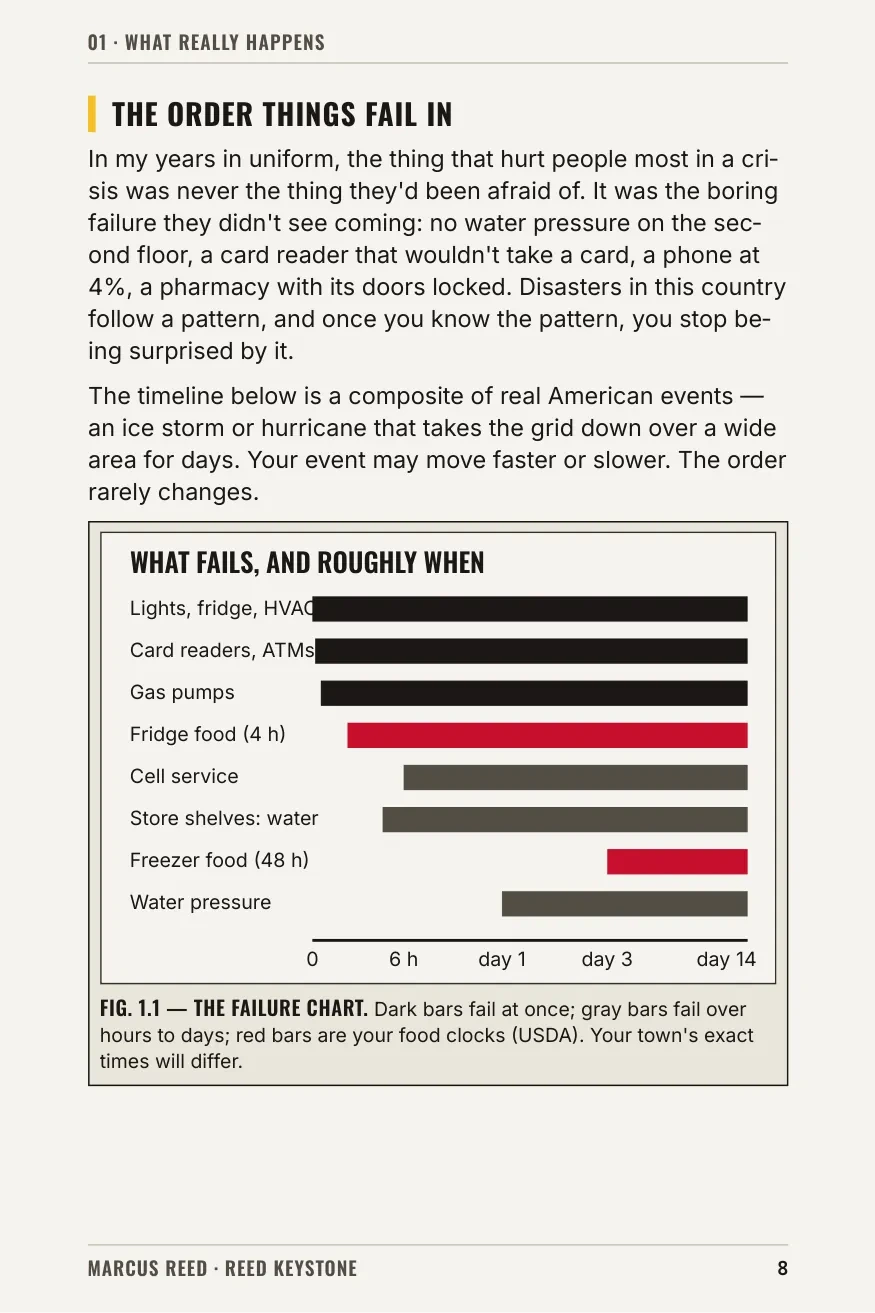
Page 8: The failure chart: what stops working in an American town from hour 0 to day 14 of a blackout
What fails first, hour 0 to day 14

Lights, card readers, gas pumps, the fridge at 4 hours, the freezer at 48, cell service, water pressure. The order comes from Texas 2021, Ida 2021 and Helene 2024.

Original page 19 + Tap to read full size
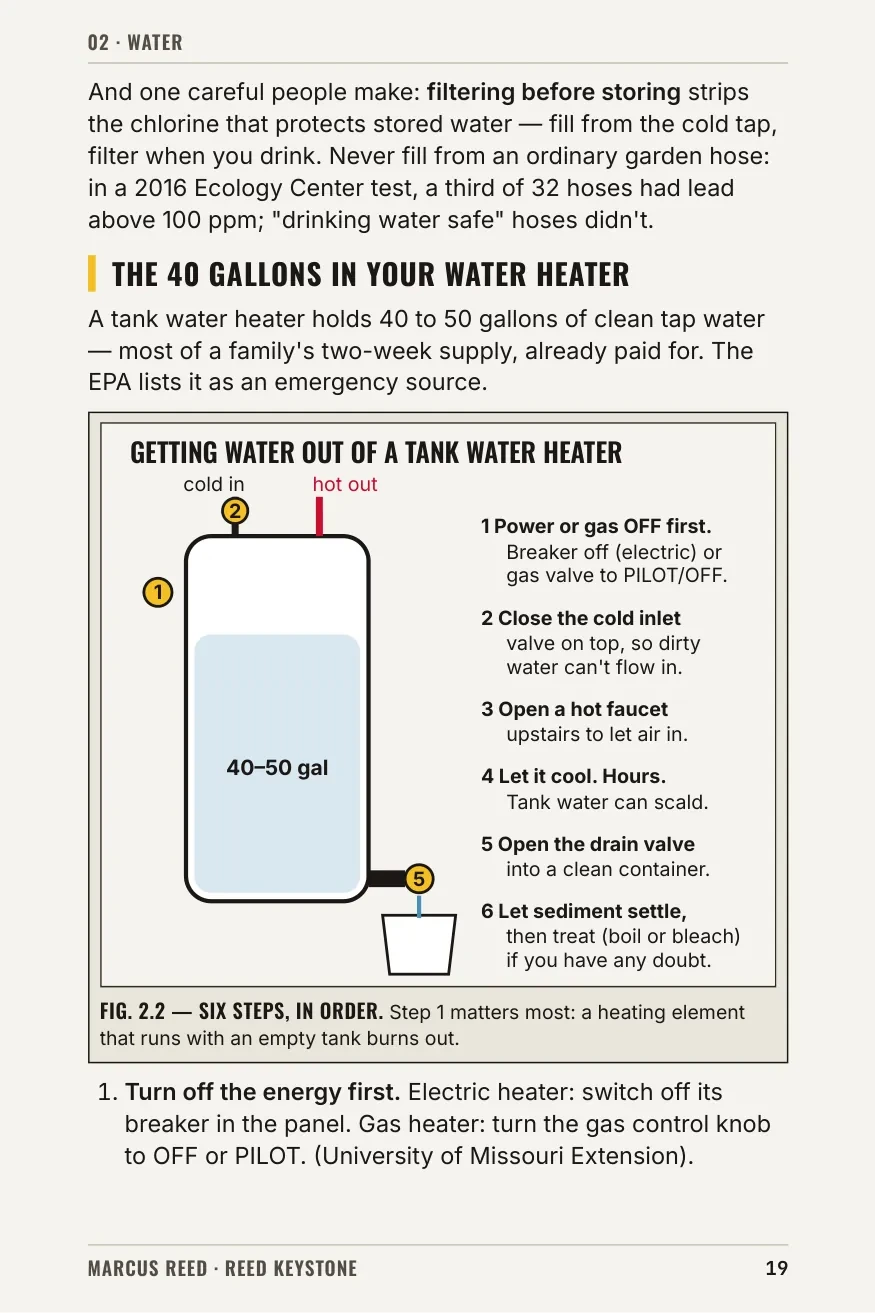
Page 19: Diagram of a tank water heater with the six numbered steps to drain it safely
The 40–50 gallons in your water heater

Six steps in the right order: energy off first, cold inlet closed, let it cool. Clean water out, and a heater that doesn't burn out.

Original page 23 + Tap to read full size
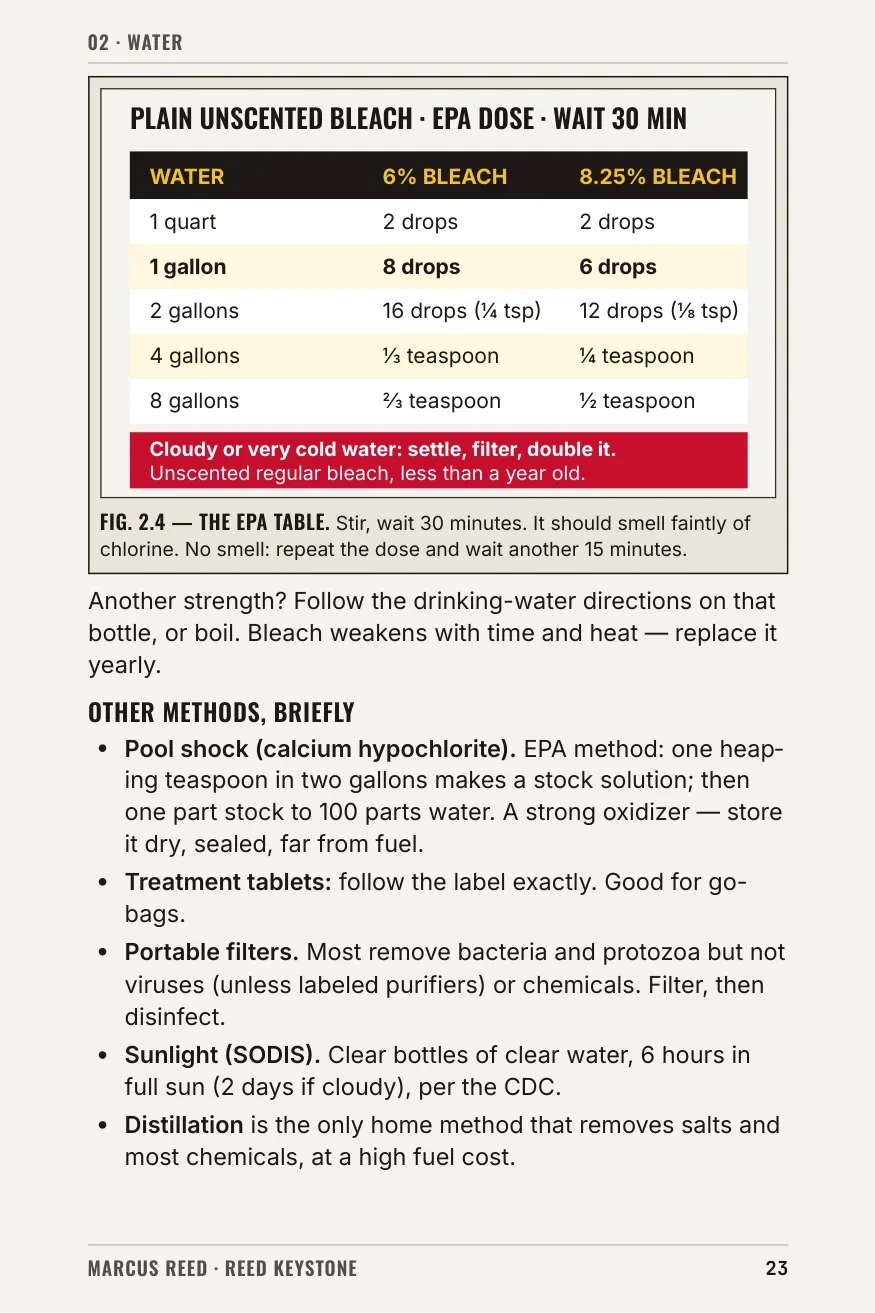
Page 23: Table of bleach drops per quart and gallon for 6 and 8.25 percent bleach, from the EPA
The EPA bleach table

Drops per quart and per gallon for 6% and 8.25% bleach, double for cloudy water, wait 30 minutes. Made to tape inside a cabinet door.

Original page 27 + Tap to read full size
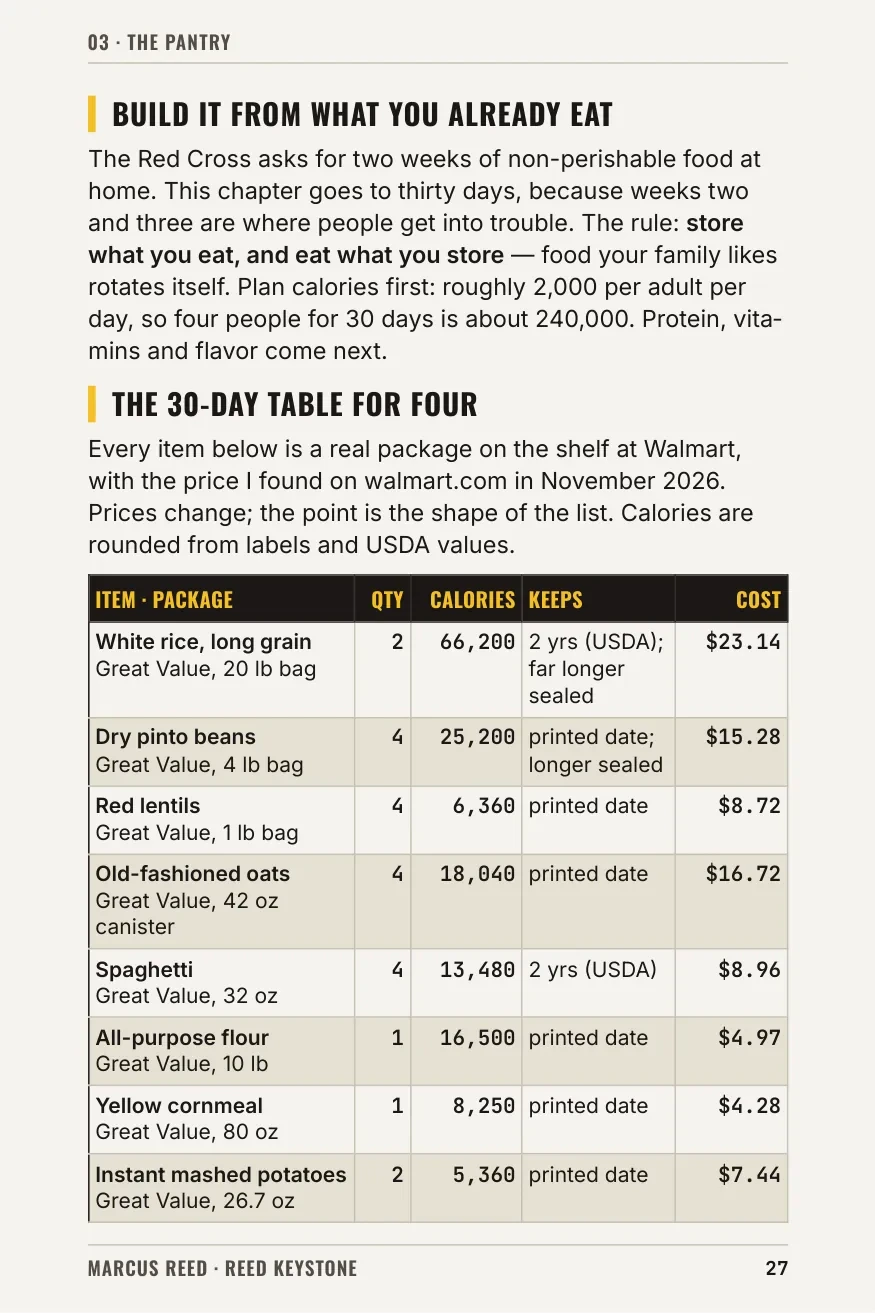
Page 27: Pantry table for four people for 30 days with Walmart packages, calories, shelf life and prices
The 30-day table for four

Real Walmart packages with quantity, calories, shelf life and the November 2026 price. Total: 252,730 calories for $314.81.

Original page 44 + Tap to read full size
Page 44: Chart of how long a fridge, a half-full freezer and a full freezer keep food safe with the door shut
Three clocks after the power goes

Fridge 4 hours, half-full freezer 24, full freezer 48 (USDA), and the first-hour list that keeps the clock from jumping forward.

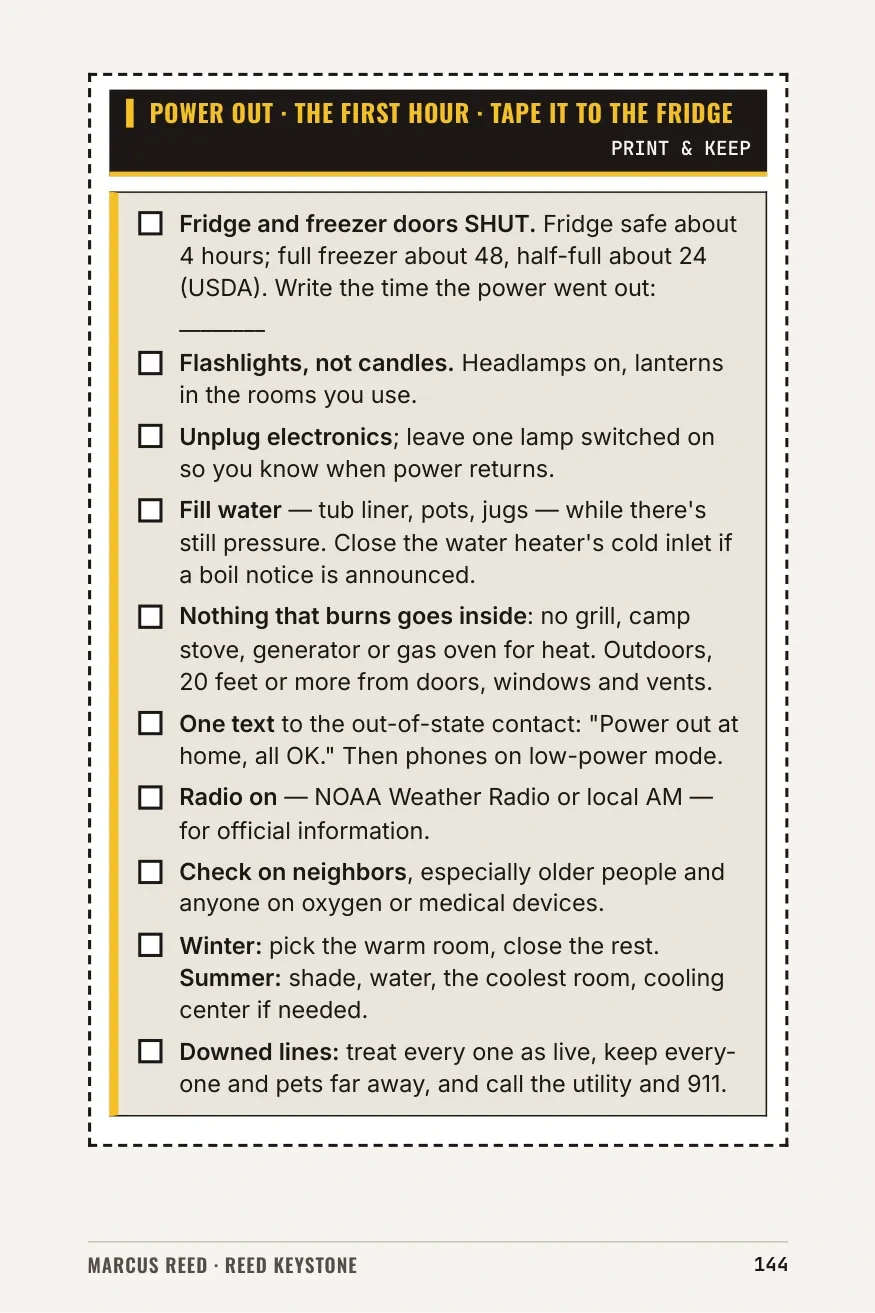
Original page 144 + Tap to read full size
Page 144: Print-and-keep sheet with ten things to do in the first hour of a power outage
Power out: the first hour

A print-and-keep sheet for the fridge door. Ten lines anyone in the house can follow in the dark.

Get the complete package (main guide + 2 free bonuses + app) for $19.90 →

Was $49.90, today only $19.90 · Secure checkout by Hotmart · 7-day money-back guarantee

Included free in the package today

These 2 bonus guides come FREE with it today

When you get the complete guide during the 24-hour offer, I add these two full bonus guides to your package at no extra cost ($0):

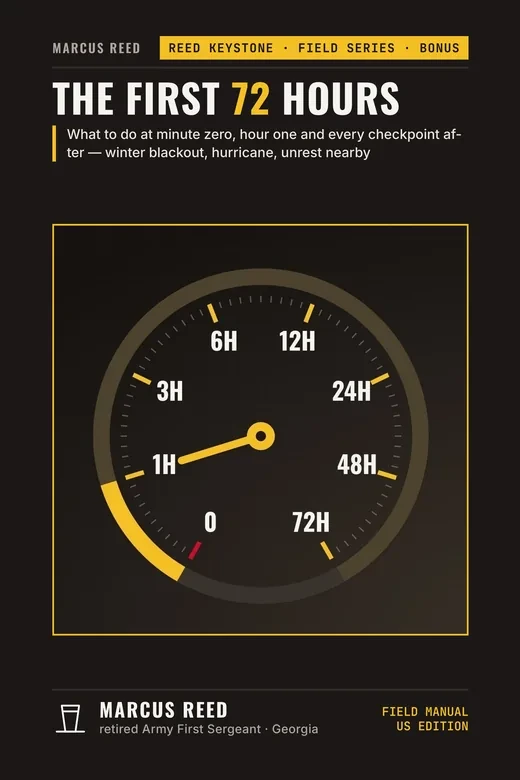
Bonus guide 1: The First 72 Hours, an hour-by-hour plan for blackouts, hurricanes and unrest
BONUS GUIDE 1 · 41 PAGES FREE ($0) Value: $15.00

The First 72 Hours – An Hour-by-Hour Plan for Blackouts, Hurricanes and Unrest

Most people who get hurt aren't hurt by the storm. They're hurt by what they do in the dark: the grill in the garage, the drive into a flooded underpass, the fridge opened ten times. This guide is a clock: 8 checkpoints from minute zero to hour 72, each with a card that says what to do, why, and what not to do.

Three scenarios, hour by hour: winter blackout (with what really happened in Texas in 2021), hurricane and flood, and unrest or looting nearby: how to stay out of sight and out of trouble. Plus the first 15 minutes of a tornado, wildfire, earthquake or flash flood, a wall chart for each scenario and a wallet card.

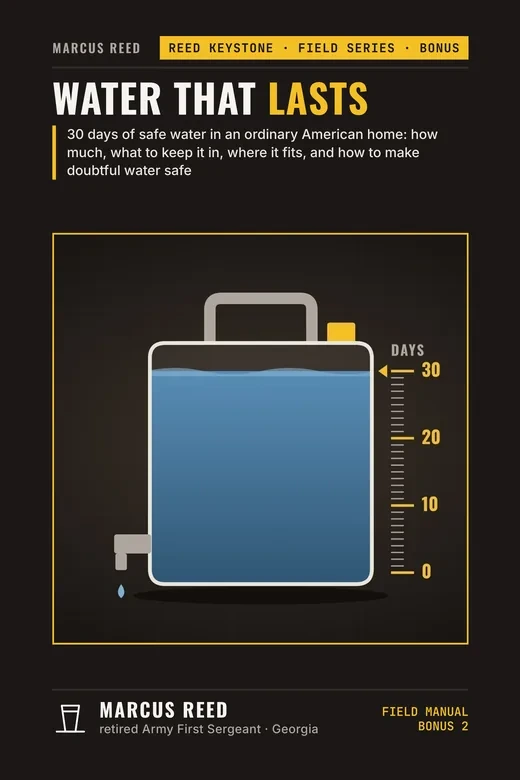
Bonus guide 2: Water That Lasts, 30 days of safe water in an ordinary American home
BONUS GUIDE 2 · 38 PAGES FREE ($0) Value: $15.00

Water That Lasts – 30 Days of Safe Water in an Ordinary American Home

Two weeks is the minimum. This takes you to 30 days: about 120 gallons for four. Which containers to buy at Walmart and what they cost, where that much water fits in an apartment, and the six-month rotation habit that keeps it good.

Ten mistakes, each with the fix. The water already in your house, by type of water heater. A four-question chart for making doubtful water safe: boiling, bleach (the CDC dose for any 5–9% bleach: 8 drops per gallon), and what filters do and don't remove. Rain from your roof, the three city notices, and sheets to print.

Also free in the package

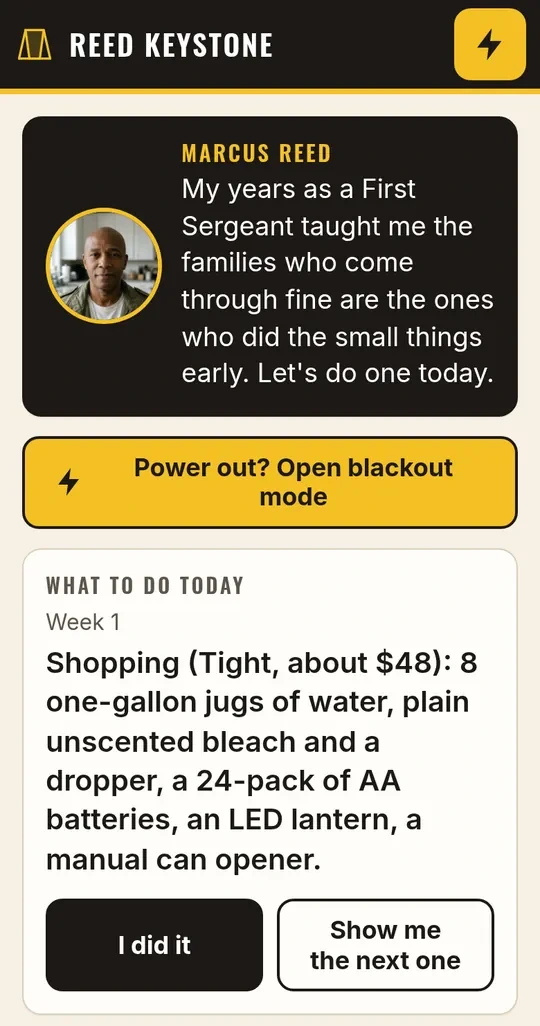
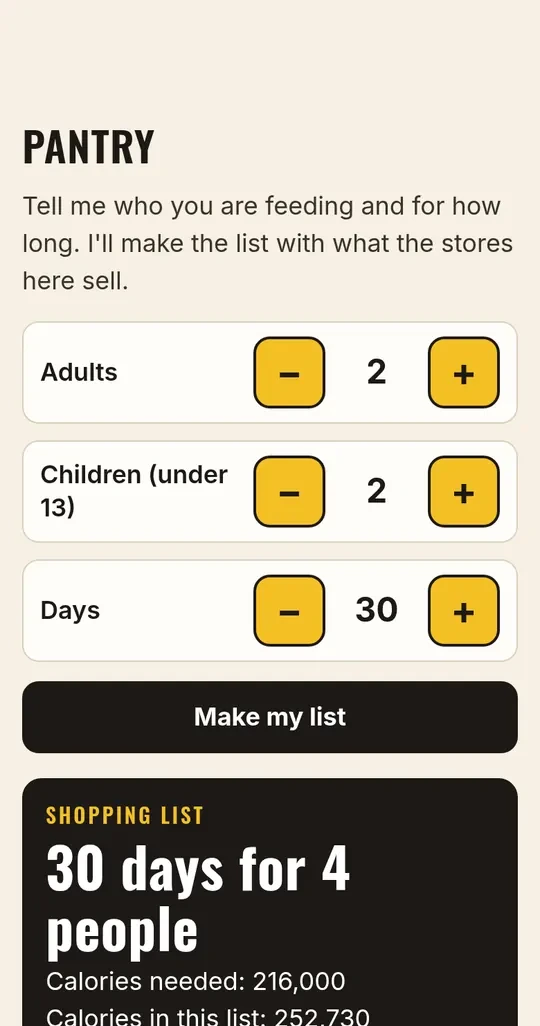
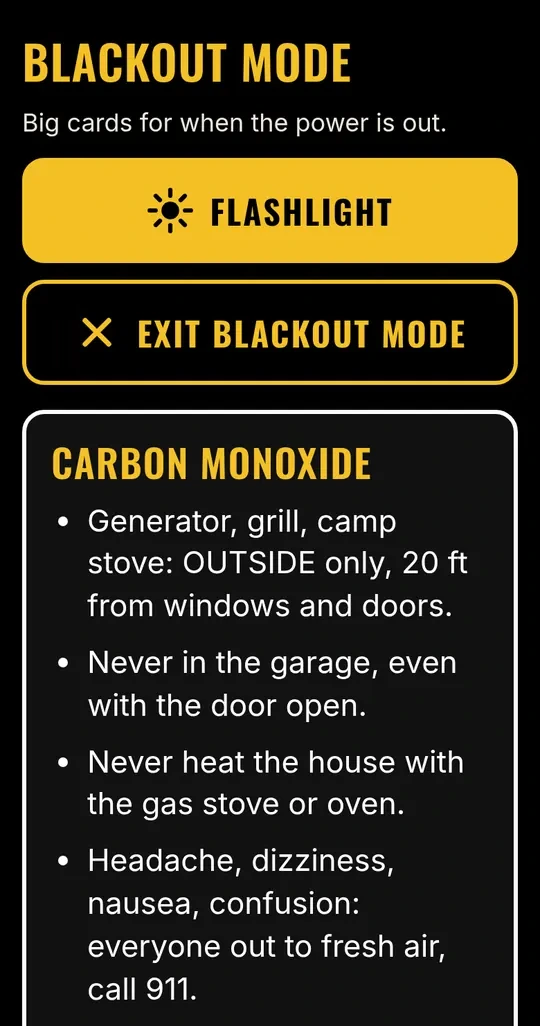
The companion app: your plan on your phone

Screen of the companion app
Real screens from the app · tap one to see it full size

The guides are for reading and printing. The app is for the day itself. There is no app store and nothing to install: you tap the link in your email, it opens in your phone or tablet browser, and you can save it to your home screen. It keeps working offline after the first visit and needs no account.

  • 72-hour plan with checkboxes for each of the three scenarios
  • Pantry calculator: people × days → your shopping list, with U.S. store products
  • Water calculator in gallons for your household
  • Expiry log that warns you 30 days before a date runs out
  • Family emergency card to fill in and print
  • Search the 72 video answers, with the page in the guide
  • Blackout mode: big cards for cooking, the fridge, water and carbon monoxide
Your author

Who I am, and why I wrote this guide

Marcus Reed, retired Army First Sergeant
Marcus Reed (55), retired Army First Sergeant

I'm Marcus Reed, 55. I retired from the Army as a First Sergeant, which mostly means I spent years making sure two hundred people had water, food, a plan and a ride home. I live in Georgia, in hurricane country, where you learn to fill the tub before the wind comes.

Leading soldiers teaches you that people don't fail in a crisis because they're weak. They fail because nobody gave them a list and a deadline. The boring things done early, like water stored, prescriptions refilled, a folder by the door and half a tank of gas, beat any expensive gear bought in a panic.

That's what this guide is: the system I use for my own family, written down so you can copy it. Every number comes from a U.S. source you can check. It's printed large, with one short task at the end of every chapter and a 30-day plan in three budgets.

Marcus Reed Marcus Reed · Retired Army First Sergeant · Georgia
✓ 7-day money-back guarantee · No questions asked

My handshake promise: you carry zero risk

I'd rather lose a sale than keep money from someone this didn't help. Open the main guide and both bonus guides, read the water chapter, hold the pantry table up against your own cabinets, and print the first-hour sheet for your fridge door.

If you're not satisfied for any reason within 7 days, reply to your purchase receipt with one line and you get your $19.90 back in full. No questions asked.

Straight answers before you order

Common questions about the guide

1. I've never prepared for anything. Is this too much for me?
No. It's written for ordinary houses and people starting from zero. Every chapter ends with one short task, with the minutes, amounts and dollars spelled out, and the 30-day plan tells you what to buy each week in three budgets: about $50, $135 or $300 a week. Where a job belongs to a licensed professional, like a generator transfer switch or turning the gas back on, the guide says so.
2. Does it fit my home: apartment or house, and my part of the country?
Yes. Cooking and storage are split by apartment or condo versus a house with a yard, with the fire-code rules for balconies. The hazard table covers hurricanes on the Gulf and Atlantic coasts, tornadoes and ice storms in the Plains, Midwest and South, wildfire and heat in the West, blizzards in the North and mountain states, and river flooding anywhere.
3. How do I get it, and how do I pay?
The secure checkout is run by Hotmart, the platform that handles the payment and your receipt. You pay once, by card or another method shown at checkout. Right after you order, Hotmart sends you an email with your access (the first time, it may ask you to choose a password). Read everything on your phone, tablet or computer, keep it for offline reading, and print the sheets on ordinary letter paper.
4. Can I read it without squinting?
That was a rule from the first page. Large type, strong contrast on a warm cream page, short paragraphs, and every table and diagram can be zoomed on a tablet or phone. The print-and-keep sheets are made for a pen and a refrigerator door.
5. Is it up to date?
Yes. Everything is current as of November 2026: the official numbers from Ready.gov, FEMA, the CDC, the EPA, the USDA, NOAA and the Red Cross, and store prices checked on walmart.com in November 2026. Prices change, and the guide says so. The sources are listed at the back, so you can check any number yourself.
6. Is there a subscription or anything to pay later?
No. It's a one-time payment of $19.90 (instead of $49.90). No subscription, no automatic renewal, no later charges. Your access doesn't expire.
Everything you get today

Get all three guides and the app at the video-viewer price

  • REED KEYSTONE, the complete guide (149 pages): water, food, cooking, cold, light and heat, security, health, cash and papers, staying in touch, leaving home, the 30-day plan, all 72 video answers and 7 print-and-keep sheets
  • BONUS 1 – The First 72 Hours (41 pages): 8 checkpoints, 3 scenarios hour by hour, wall charts and a wallet card – free today ($0)
  • BONUS 2 – Water That Lasts (38 pages): 30 days of safe water, ten mistakes and the fix, the treatment chart – free today ($0)
  • The companion app: 72-hour checklist, pantry and water calculators, expiry log, family card, blackout mode – free today ($0)
  • Instant access by email: phone, tablet, computer and printer, covered by the 7-day money-back guarantee
60% off + 2 free bonus guides ends in: 23:59:59
was $49.90 today only $19.90 −60%
Get the complete package for $19.90 →

One-time payment of $19.90 · No subscription · Secure checkout by Hotmart · Instant access by email